Brazil nuts: crop improves significantly
August 19, 2026 at 10:10 AM ,
Der AUDITOR
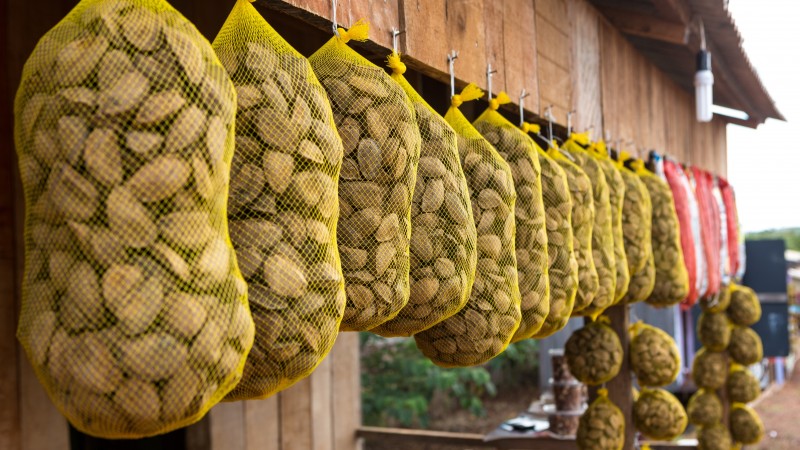
Better weather conditions
The 2025 crop totalled around 19,400 mt of shelled Brazil nuts and was consequently considerably lower due to significant declines, particularly in Bolivia and Peru. Drought and high temperatures in the Amazon region were cited as the reasons for the poor crop. For the 2026 crop, however, a recovery in production is expected in the main producing countries, supported by better conditions.
As discussed at the International Nut and Dried Fruit Council (INC) congress in Macao, prices were initially exceptionally high following the poor 2025 crop. They subsequently fell sharply before stabilising and rising again. With available volumes remaining limited, upward pressure on prices continued as the season progressed. Fluctuations in availability are quickly reflected in prices. Currently, the price for medium-sized Brazil nuts from Bolivia stands at EUR 13.50/kg FCA NL.
|
Brazil nut kernels, Bolivia |
|
|
Size |
EUR/kg |
|
Medium |
13.50 |
|
Midget |
12.75 |
|
Broken |
9.90 |
|
FCA NL; price indications |
|
Availability influences demand and trade
The market reacts differently depending on the extent of the crop decline. In the case of more moderate declines, rising prices have little effect on demand, particularly if other nuts also become more expensive. In the event of more severe crop failures, however, retailers restrict availability, reduce pack sizes or remove Brazil nuts from certain product categories, such as mixed nuts. In years of extreme scarcity, such as 2025, there is an increasing trend towards wider delisting, as limited availability and high prices lead to a significant drop in demand.
According to the INC, experience following the crop failures of 2017 and 2025 shows that Brazil nuts are resilient. Although many retailers temporarily removed Brazil nuts from their ranges during the shortages, the majority reintroduced them once supplies improved.
China’s buying interest is growing
China is showing growing interest in Brazil nuts, particularly due to increased awareness of the health benefits of selenium. At the same time, demand remains price-sensitive. Flavoured and chocolate-coated Brazil nuts are opportunities for expanding consumption. Further growth opportunities are seen amongst younger consumers and in markets where consumption has so far been relatively low, particularly in South-East Asia.
Global production is estimated at 105,300 mt of in-shell Brazil nuts for the 2026/27 season. This would represent an increase of 80.9% compared with the 58,200 mt recorded in the 2025/26 season. Bolivia continues to account for the largest share, with an expected 80,100 mt following 45,000 mt in the previous year, representing an increase of 78.0%. Peru is expected to increase its production from 9,300 to 16,500 mt (+77.4%). In Brazil, a particularly sharp rise is anticipated, from 3,900 to 8,700 mt, representing an increase of 123.1%.
|
Global Brazil nut production, inshell, in mt |
|||
|
Origin |
2025/26 |
2026/27 |
Diff. |
|
Bolivia |
45,000 |
80,100 |
78.0% |
|
Peru |
9,300 |
16,500 |
77.4% |
|
Brazil |
3,900 |
8,700 |
123.1% |
|
Total |
58,200 |
105,300 |
80.9% |
|
INC, July 2026 |
|||
View more
- price charts
View related articles