Almonds: larger acreage increases production potential
February 16, 2026 at 4:32 PM ,
Der AUDITOR
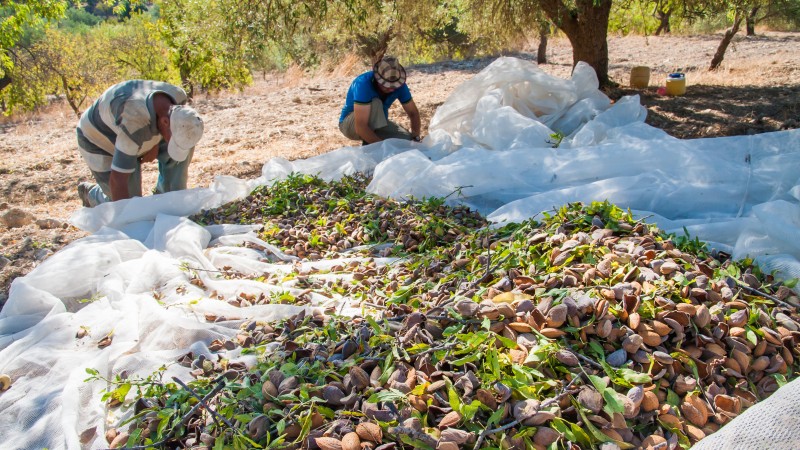
New areas become productive
The Australian almond industry expects a crop of 166,891 mt for the new season. According to Tim Jackson, Chairman of the Almond Board of Australia, the forecast is around 7% above last year's level and 3,000 mt above the previous record. This is due to favourable growing conditions, very good pollination and new plantations that are now fully productive. Around 20,000 hectares were planted during the 2017-2019 expansion phase.
Prices have recently been stable and at their highest level in years. However, the exchange rate is a cause for greater concern: As exports are settled in US dollars, a stronger Australian dollar reduces producers' revenues – even if market prices remain unchanged.
Harvesting has already begun and is expected to be completed by April if the dry weather continues. Although the ongoing drought is making harvesting easier, it is putting pressure on water reserves and prices. The heat is also causing different varieties to reach full maturity at the same time.
Higher shipments to Spain and Vietnam
In December 2025, Australian almond traders shipped a total of 10,915 mt of shelled and unshelled almonds domestically and overseas, representing a 23.7% decrease compared to the same month last year. Exports fell by around a quarter to 9,624 mt, but still represent the second-best result on record, whereas domestic deliveries not only fell by 9% to 1,291 mt, but also reached their lowest level since 2014. The main buyer in December was Vietnam (+190.5% to 4,018 mt), followed by China (-46.8% to 3,166 mt), Turkey (-67.8% to 596 mt) and Spain (+877% to 596 mt).
Since the start of the season, 145,995 mt of Australian almonds, both shelled and unshelled, have been shipped domestically and overseas. Although this is 8% less than last year at this time, shipments are still well above the 5-year average of 118,844 mt, easily making this the second-highest result.
Domestic demand fell by 7.5% year-on-year to 19,872 mt, the lowest level since 2018 and around 2,200 mt below the five-year average. Although exports also declined by 8% year-on-year, the 126,123 mt still represent the second-best export result in history. At 74,413 mt, around 59% of Australian almond exports went to China, followed by India (11.6%), Vietnam (9.7%), Turkey (5.9%) and Germany (2.7%).
|
Almond shipments*, Australia, in mt |
|||
|
Destination |
2024/25 |
2025/26 |
Diff. |
|
China |
75,030 |
74,413 |
-0.8% |
|
Australia |
21,483 |
19,872 |
-7.5% |
|
India |
19,536 |
14,568 |
-25.4% |
|
Vietnam |
8,171 |
12,258 |
50.0% |
|
Turkey |
9,779 |
7,388 |
-24.5% |
|
Germany |
4,437 |
3,405 |
-23.3% |
|
Spain |
3,324 |
2,516 |
-24.3% |
|
New Zealand |
2,045 |
1,763 |
-13.8% |
|
Thailand |
1,666 |
1,343 |
-19.4% |
|
UAE |
3,703 |
1,193 |
-67.8% |
|
Others |
9,568 |
7,276 |
-24.0% |
|
Total |
158,742 |
145,995 |
-8.0% |
|
Almond Board of Australia; Mar-Dec *shelled and inshell |
|||
View more
- price chart, almonds, Mamra, Iran
- price chart, almonds, natural 13/14, Largueta
- price chart, almonds, blanched, 27/30, California SSR
- more price charts
View related articles