
Almonds: EU importers swallow high prices
April 23, 2025 at 11:40 AM ,
Der AUDITOR
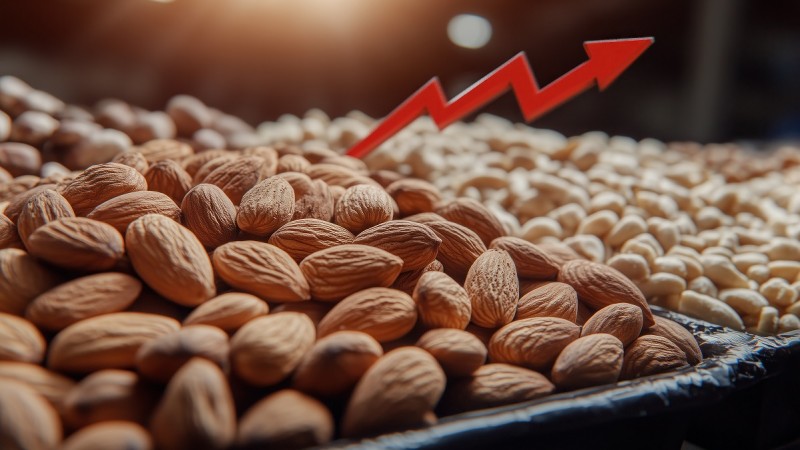
Divided opinions on EU tariffs
US producers such as Olam have responded with relief to the EU’s decision to implement an additional 25% retaliatory tariff for US almonds as late as 1 December in response to Trump’s 25% tariff on steel and aluminium imports from the bloc. Not only does this provide certainty for EU buyers but hope is also that this will boost shipments to the EU in the coming months.
Opinions within the EU are, however, divided. Issue is that industry stakeholders heavily rely on almond imports from the US and the International Nut and Dried Fruit Council has participated in talks with the EU Commission to highlight the impact such high tariffs will have on everyday business. Contrary to this, organic almond producers in Spain emphasise that the tariffs present a chance to establish a more level playing field as Spain’s organic almonds stand no chance in competing with cheap imports from the US. Apricot kernel producers also see the tariffs as a chance to promote their products as a viable alternative for almonds. Official EU import statistics, however, show how much the bloc depends on US almonds.
High dependency on US almonds
EU importers have, in fact, bought 172,209 mt of shelled almonds worth EUR 816 million (USD 932 million) this season so far. This is 6% less than the 183,997 mt imported in the same period last season. In terms of volume imports have, by contrast, risen by 17% on the EUR 695 million (USD 794 million) spent last year driven by the prevailing high price levels in California. This clearly shows that EU buyers have already accepted higher prices for US almonds with California SSR almonds presently trading a stunning 57% higher than last year in Spain.
Shipments from the US, in fact, account for as much as 93% of the total volume imported in 2024/2025. The volumes shipped from Australia, the world’s second largest producer, are much smaller and third-placed Vietnam also relies on US imports. Imports from producing EU member states, such as Spain, Portugal, Italy and Greece may have more than doubled this season, but EU production cannot cover domestic demand.
|
EU almond imports (mt) |
|||
|
Partner |
2023/24 |
2024/25 |
Diff. |
|
USA |
171,131 |
160,501 |
-6.2% |
|
Australia |
10,872 |
9,398 |
-13.6% |
|
Vietnam |
869 |
736 |
-15.3% |
|
EU |
217 |
566 |
160.8% |
|
South Africa |
0 |
317 |
- |
|
Chile |
379 |
153 |
-59.6% |
|
Morocco |
92 |
84 |
-8.7% |
|
Afghanistan |
71 |
83 |
16.7% |
|
Canada |
20 |
80 |
300.0% |
|
Pakistan |
60 |
60 |
0.0% |
|
Others |
285 |
230 |
-19.3% |
|
Total |
183,997 |
172,209 |
-6.4% |
|
Provisional data, DG TAXUD Customs Surveillance, 05/08-20/04 |
|||
View more
- price chart, almonds, Mamra, Iran
- price chart, almonds, natural 13/14, Largueta
- price chart, almonds, blanched, 27/30, California SSR
- more price charts
Attached Files

View related articles