Nuts: EU spends incredible amounts
February 10, 2026 at 12:42 PM ,
Der AUDITOR
USA as most important trading partner
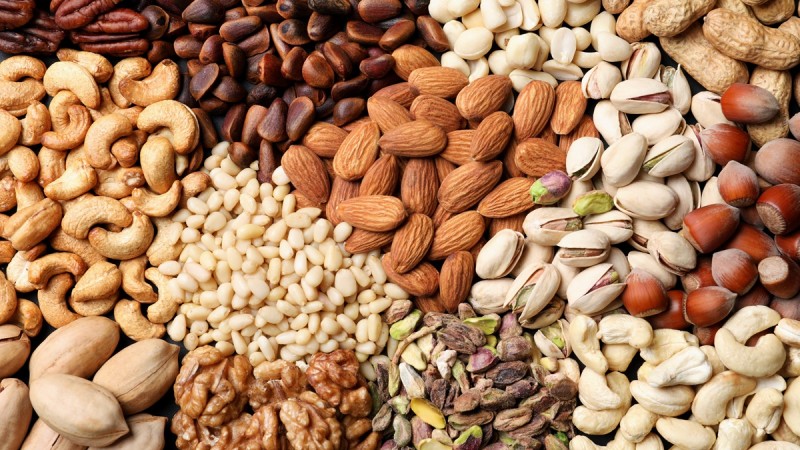
Last year, the EU spent a record EUR 7.6 billion (USD 9 billion) on various fresh and dried nuts as weekly import data supplied by the European Commission’s Directorate-General for Agriculture and Rural Development (DG AGRI) shows. In accounting for an impressive 43% of the EU’s total import value the USA were the most important trading partner by far. Vietnam accounted for 12%, followed by Argentina with 9% and Chile with 8%. Germany was the largest importing EU member state with a share of 29%, followed by the Netherlands with 21% and Italy with 18%. Spain accounted for 14%.
Importers spent record amounts on pistachios, cashews and walnuts, hazelnuts, macadamias and Brazil nuts. Almonds showed an impressive gain, whereas the import value for pine nuts and pecans only moderately rose. By contrast, the import value fell for peanuts and kola nuts.
Pistachios are the trending nut in the EU. In 2025, imports surged by 33% to nearly EUR 1.5 billion (USD 1.8 billion), which is an absolute record. With a market share of 79% the USA was the main supplier by far. Iran (8%) and Turkey (6%) followed with much smaller shares. Germany (34%), Italy (25%) and Spain (12%) were the main importing EU member states.
After taking a dip in 2024, the EU’s almond imports recovered to well above the EUR 1 billion (USD 1.2 billion) threshold to the third highest volume on record of EUR 1.4 billion (USD 1.7 billion). Imports only reached higher levels in 2015 (EUR 1.8 billion, USD 2.1 billion) and 2016 (EUR 1.5 billion, USD 1.8 billion). Unsurprisingly, the USA as the world’s leading producer accounted for as much as 94% of the EU’s total import value in 2025. Australia only held a minor market share of 3%. Vietnam was next in line with less than than 1%. Spain (26%), Germany (24%) and Italy (18%) spent most on almonds last year.
Cashews also reached a record exceeding EUR 1 billion (USD 1.2 billion) for the second year in a row. Processor Vietnam was the EU’s leading trading partner with a market share of 70%, followed by the Ivory Coast with 16% and India with 6%. Germany (35%), the Netherlands (33%) and Spain (10%) are the main EU importing states.
EU walnut imports surged above EUR 1 billion for the first time on record. The USA remained the most important trading partner in 2025 with a market share of 48%. Chile’s share rose a bit to 26%, followed by China with 11%. Within the EU Germany (39%), Spain (18%) and Italy (16%) were the main buyers.
After EU importers also spent more than EUR 1 billion (USD 1.2 billion) on shelled and in-shell peanuts in the two consecutive years of 2023 and 2024, imports dipped a bit in 2025. Argentina was the main trading partner by far with an impressive market share of 65%. China was next in line with 11%, followed by the USA with 7%. The Netherlands accounted for as much as 55% of the EU’s total import value in 2025, followed by Spain (8%) and Italy (7%) with much smaller single-digit shares.
Hazelnut imports climbed to a record EUR 832 million (USD 990 million) in 2025. Yet a noted shift took place as Turkey as the world’s leading producing country no longer was the EU’s most important trading partner. This place was taken by Chile, which accounted for 42% of the EU’s total import value in 2025. Turkey only held a market share of 29%, followed by the USA with 11%. Within the EU Italy (40%) was the main buyer, followed by Germany (32%) and Poland (8%).
EU spending on pine nuts rose again in the past three years. While declining to EUR 160 million (USD 190 million) in 2023, the value stood 9% higher in 2025 at EUR 174 million (USD 207 million). China received as much as 76% of the EU’s total import value with Turkey (14%) and Russia (4%) next in line. Germany was the main buyer (48%) along with Italy (20%) and the Netherlands (11%)
EU pecan imports rose by 13% to EUR 168 million (USD 200 million) in 2025 with the USA holding a market share of 51% and Mexico of 45%. South Africa was next in line but only accounted for as little as 3% of the EU’s total import value. With 41% the Netherlands were the leading buyer within the EU, followed by Germany (28%), Spain (11%) and France (7%).
The import value for macadamia nuts surged by 63% to a record EUR 124 million (USD 148 million) in 2025. In accounting for 54% of the total import value South Africa was the EU’s main trading partner. Kenya held a market share of 25% and Australia as little as 8%. The Netherlands (38%) and Germany (34%) accounted for the lion’s share of the import value, followed by Spain with a much smaller share of 12%.
For Brazil nuts the import value climbed to a record EUR 108 million (USD 129 million) in 2025. This is, in fact, only the second time imports exceed EUR 100 million (USD 119 million), the first time being in 2022 when they rose to EUR 107 million (USD 127 million). Bolivia held a near monopoly of 85% in 2025, whereas Peru (9%) and Brazil (4%) sported much smaller market shares.
After reaching a record in 2024, the EU imports for kola nuts fell to the second highest value of EUR 2.2 million (USD 2.4 million) in 2025. Côte d'Ivoire was the main trading partner (25%), closely followed by Jamaica (21%) and India (20%). France accounted for as much as 59% of the EU’s total import value in 2025 with Germany (15%) and Spain (12%) next in line.
|
EU nut imports (EUR) |
|||
|
Product |
2024 |
2025 |
Diff. |
|
Pistachios |
1,118,892,835 |
1,490,137,884 |
33.2% |
|
Almonds |
966,695,852 |
1,446,428,200 |
49.6% |
|
Cashews |
1,027,253,593 |
1,252,688,253 |
21.9% |
|
Walnuts |
686,901,807 |
1,024,391,560 |
49.1% |
|
Peanuts |
1,145,938,595 |
1,008,406,299 |
-12.0% |
|
Hazelnuts |
571,576,897 |
832,579,981 |
45.7% |
|
Pine nuts |
163,327,300 |
174,375,908 |
6.8% |
|
Pecans |
149,056,537 |
167,675,121 |
12.5% |
|
Macadamia nuts |
75,937,280 |
123,520,596 |
62.7% |
|
Brazil nuts |
93,759,647 |
108,263,891 |
15.5% |
|
Kola nuts |
2,549,421 |
2,222,241 |
-12.8% |
|
Others |
2,345,198 |
2,433,526 |
3.8% |
|
Total |
6,004,234,962 |
7,633,123,460 |
27.1% |
|
DG TAXUD Customs Surveillance, 01/01-31/12 |
|||
View more
- price charts for nuts, dried fruit, oilseeds and many more products
View related articles