Almonds: rain delays harvest
March 16, 2026 at 4:12 PM ,
Der AUDITOR
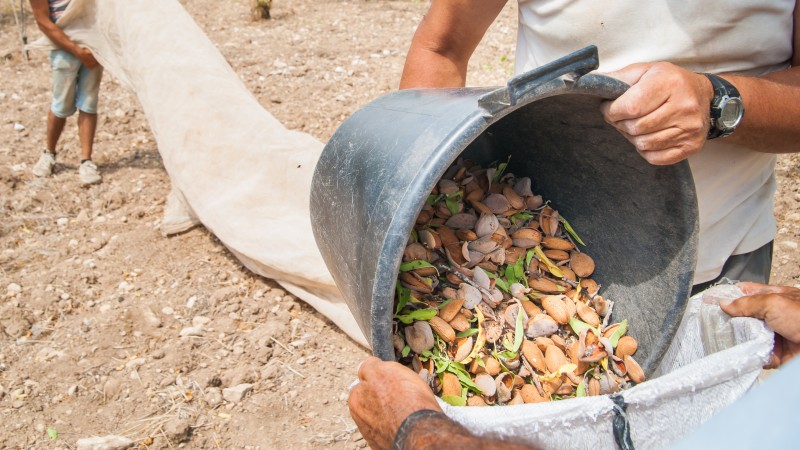
Yields could be affected
Heavy rainfall had delayed the almond harvest in Australia in early March. According to Tim Jackson, chief executive of the Australian Almond Board, harvesting had only just begun in the affected regions of South Australia, Victoria and New South Wales when the weather-related disruption occurred. This forced growers and processors to take drying measures to prepare for processing and packaging, according to the latest report from the Australian Almond Board.
"When you do get rain like this, brown rot can start and you can lose quite a bit of your crop", Fruit Growers Victoria industry development officer Michael Crisera told ABC News.
It was only at the end of January that the estimate for this year’s almond crop was published. At that time, experts were still forecasting a yield of 166,892 mt of shelled almonds, which would have represented a 7% increase on the previous year. It now remains to be seen, however, what effect the rainfall has had on production.
Weak exports just before the change of season
The strong export performance of Australian almonds this season reflects high buying interest, even though prices had been trending more in favour of sellers.
In January 2026, Australian almond traders shipped a total of 3,008 mt of shelled and unshelled almonds domestically and overseas, representing a 42.8% decline compared with the same month last year. Exports fell by more than half to 1,423 mt. Although domestic deliveries declined by 26% to 1,585 mt, they remain higher than exports – a trend that typically only occurs during the change of season, when stocks are running low and the new crop is not yet fully available. The main buyers in January, after Australia itself, were China (-10.8% to 378 mt), followed by Spain (+386.9% to 2.97 mt), Turkey (-86.8% to 229 mt) and India (+64.0% to 146 mt).
Since the start of the season, 148,888 mt of Australian almonds, both inshell and shelled, have been shipped domestically and overseas. Whilst this is 9.2% less than at this time last year, shipments are still comfortably on track to achieve the second-highest total.
Domestic demand fell by 9.2% year-on-year to 21,457 mt, and exports also dropped by 9.2%; however, the 127,431 mt still represent the second-highest export figure on record. At 74,791 mt, around half of Australia’s almond exports went to China, followed by India (9.9%), Vietnam (8.2%), Turkey (5.1%) and Germany (2.3%).
|
Almond shipments*, Australia, in mt |
|||
|
Destination |
2024/25 |
2025/26 |
Diff. |
|
China |
75,454 |
74,791 |
-0.9% |
|
Australia |
23,625 |
21,457 |
-9.2% |
|
India |
19,625 |
14,713 |
-25.0% |
|
Vietnam |
8,256 |
12,174 |
47.5% |
|
Turkey |
11,488 |
7,617 |
-33.7% |
|
Germany |
4,549 |
3,486 |
-23.4% |
|
Spain |
3,385 |
2,813 |
-16.9% |
|
New Zealand |
2,191 |
1,820 |
-16.9% |
|
Thailand |
1,732 |
1,361 |
-21.4% |
|
UAE |
3,805 |
1,193 |
-68.6% |
|
Others |
9,895 |
7,463 |
-24.6% |
|
Total |
164,005 |
148,888 |
-9.2% |
|
Almond Board of Australia; Mar-Jan *shelled and inshell |
|||
View more
- price chart, almonds, Mamra, Iran
- price chart, almonds, natural 13/14, Largueta
- price chart, almonds, blanched, 27/30, California SSR
- more price charts
View related articles